Wednesday, November 7, 2012

Climate Change

Remember my early post entitled "how close"? In class, Maher suggested that Neanderthal and AMH population turnovers in the Levant were closely linked to abrupt climatic shifts. 


Neandog: "I just can't handle this heat"

http://danshamptons.com/2012/07/18/this-is-how-im-feeling-about-the-weather-lately-in-the-hamptons/

Some archeologists suggest that climate change did have a significant part to play in Neanderthal extinction. 


According to this, Gerd-Christian Weniger and his team from the University of Keulen in Germany combined archeology, paleontology and paleogenetics to show that Neanderthals went extinct due to extreme climate. Weniger suggests that Neanderthals were not able to survive the fourth Heinrich event. The authors argue that while Neanderthals had weathered colder weather before, they were unprepared for the drought that followed. 


This article summarizes Clive Finlayson's The Humans Who Went Extinct. In his book, Finlayson also argues that climatic change was significant. According to him, Neanderthals might have actually have survived until as late as 24, 000 years ago in Spain, Portugal, and Gibraltar. Eventually, though, even this small group of survivors died out after the Heinrich 2 event. 


In this paper, Francisco Jose Jimenez Espejo and his team's analysis of marine sediments shows variation in marine productivity, which is indicative of climatic fluctuation. The authors found that these variations were closely correlated with Homo spatial and occupational patterns. They note that Neanderthals disappeared from Southern Iberia during a particularity harsh and cold climatic period, and therefore suggest that climatic factors may have wiped out Neanderthal populations in this particular geographical area between 24 and 25 thousand years ago. 


Notice that these articles suggest that cold, not heat, did Neanderthals in. Neanderthals may have been morphologically adapted to cold and may have even had clothing... 


http://www.desicolours.com/dont-animals-get-too-cold/10/11/2009

... but may not have been able to find sufficient resources to nourish themselves as hunter-gatherers. 

Some archeologists maintain that climate change did not have any role in causing the Neanderthals to go extinct. Even proponents of climate change can't seem to agree on certain key factors, like when exactly Neanderthals went extinct. If climate change did indeed play a role, perhaps it affected Neanderthals differently depending on particular geographical locations and timing. Neanderthals in the Levant might have been particularly affected by warmer weather in the Levant after 45 kya, while Neanderthals in the Iberian peninsula might not have been able to survive a particularly cold and dry phase around 24 kya.  

Two politicians who can't agree on anything


http://www.foreignpolicy.com/articles/2012/10/24/cant_we_all_just_not_get_along

Bibliography 

  • Hadley, Kathryn. "History in the News: News of the Neanderthals." History in the News. N.p., 17 Feb. 2009. Web. 9 Nov. 2012. <http://historytodaymagazine.blogspot.com/2009/02/news-of-neanderthals.html>.
  • Jiminez-Espejo , Francisco. "Climate forcing and Neanderthal extinction in Southern Iberia: insights from a multiproxy marine record." Quaternary Science Reviews 26.7-8 (2007): 836-852. Print.
  • Jones, Tim. "Neanderthals Dried Fresh Meat, Wore Tailored Clothing – Energy Study « Anthropology.net."  Anthropology.net. N.p., 26 June 2009. Web. 9 Nov. 2012. <http://anthropology.net/2009/06/26/neanderthals-dried-fresh-meat-wore-tailored-clothing-energy-study/>.
  • Lemonick, Michael D.. "The Neanderthal extinct due to extreme climate change? « Greenfudge.org." Environmental News With a Sticky Twist - Greenfudge.org. N.p., 5 Dec. 2010. Web. 9 Nov. 2012. <http://www.greenfudge.org/2010/12/05/the-neanderthal-extinct-due-to-extreme-climate-change/>.
  • Steegmann, AT Jr, FJ Cerny, and TW Holliday . "Neandertal cold adaptation: physiological and energetic factors.." American Journal of Human Biology 14 (2002): 566-83. Print.
  • Wrenn, Eddie. "Guilty! We killed the Neanderthals ... not the ice age like we previously thought (or hoped)  | Mail Online." Home | Mail Online. N.p., 24 July 2012. Web. 9 Nov. 2012. <http://www.dailymail.co.uk/sciencetech/article-2177767/Guilty-We-killed-Neanderthals---ice-age-like-previously-thought-hoped.html>.

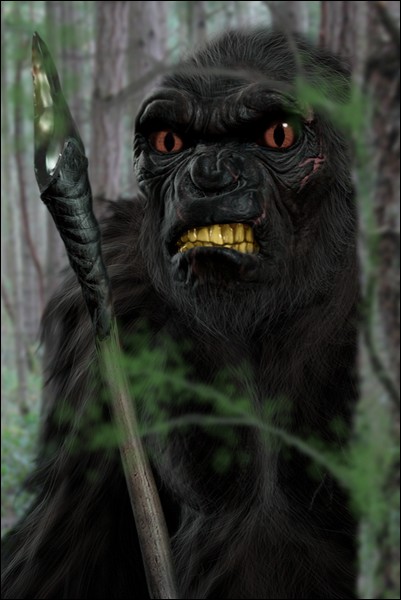
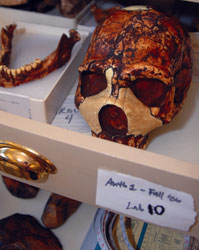
What happened to the Neanderthals?

Neanderthals went extinct around 28, 000 years ago. Archeologists are still trying to understand why. In previous posts, I tried to illustrate a shift in our understanding of Neanderthals: from inferior ape-like creatures, they are now usually imagined to be much more human-like in both appearance and behavior.

Well, not always 
http://freethoughtblogs.com/pharyngula/2012/06/19/neandertals-were-monsters/

If AMH and Neanderthals were in fact so similar, why did Neanderthals die out? Why did AMH flourish instead?
Human Demographics: we've been very successful!

http://skepteco.wordpress.com/2011/10/31/7-billion-hearts-and-minds/

Multiple theories have been advanced, with considerable evidence--yet results are often contradictory. In the next series of posts, I will address some of these hypotheses by exploring supporting evidence as well as counter-evidence.

How close?


In this post, I try to answer the questions "how close?" by taking the Levant as an example.

Geographical overlap...

Many Neanderthals sites are in close geographical proximity to AMH sites. These sites are particularly interesting, because they suggest that Neanderthals and AMH had similar ecological niches. Here, I want to look at two of these sites in more detail.

In class, we learned that the middle Paleolithic of the Levant shows a complex record of population turnover along with changing climatic conditions. Evidence for both Neanderthal and AMH populations can be found in several areas, like in Europe and the Levant (Maher Lecture 2012).
Amud Cave in Israel 
http://kennethgarrett.photoshelter.com/image/I0000YoARWqsPgbU

A series of excavations in Amud cave has yielded multiple Neanderthal remains. Between 1961 and 1964, archeologists found a young male Neanderthal skeleton, fragments of another adult jaw and skull, and remains of two Neanderthal infants dating to 50, 000-70, 000 years ago. In 1991, another expedition found another Neanderthal baby buried with the maxilla of a red deer. They also found tools and animal remains.

Neanderthal skull found at Amud Cave 
http://www.gwu.edu/~magazine/archive/2007_research_winter/features/feat_evolution.htm

Not too far off, archeologists discovered evidence for AMH presence. A 1971 expedition found human remains at Qafzeh cave. One of the skeletons was an adolescent aged about 13 years labeled Qafzeh 11. This particular individual was "lying on his back, with the legs bent to the side, and both hands place on either side of the neck, and in his hands were the antlers of a large deer".

Qafzeh and Amud, in close proximity 

http://www.sciencedirect.com/science/article/pii/S0047248411002016


...But no temporal overlap? 

According to Maher, "the Middle Paleolithic of the Levant shows a complex record of population turnover with changing climate". Population turnovers correspond to abrupt shifts in global climate (as deduced from sediment and ice cores) (Maher 2012).


From 120 to 75 kya, AMH dominated the Levant during a warm and arid climatic phase. Then, around 75 kya, a volcanic eruption triggered a global cold and dry phase. AMH disappeared from the archeological record, only to be replaced by Neanderthals from 75 to 50 kya. After 45 kya, the climate warmed considerably: Neanderthals went extinct in the Levant, while AMH reappeared in the archeological record.

In this area at least, it seems that Neanderthals and AMH overlapped geographically, but did not overlap temporally.

In later posts, we'll see that some archeologists suggest that Neanderthals and AMH overlapped both geographically AND temporally. What kinds of interactions might they have had?


Bibliography 

  • "Amud (anthropological and archaeological site, Israel) -- Britannica Online Encyclopedia." Britannica Online Encyclopedia. N.p., 7 Nov. 2012. Web. 9 Nov. 2012. <http://www.britannica.com/EBchecked/topic/21947/Amud>.
  • Maher, Lisa. “The Late Pleistocene of Southwest Asia I: The Middle Paleolithic”. Anthropology 128, UC Berkeley, 105 Stanley, 9/19/2012. 
  • "Skhul and Qafzeh hominids - Wikipedia, the free encyclopedia." Wikipedia, the free encyclopedia. N.p., 21 Sept. 2012. Web. 7 Nov. 2012. <http://en.wikipedia.org/wiki/Skhul_and_Qafzeh_hominids#Qafzeh_11>.


Monday, November 5, 2012

Where in the world?


Neanderthals enjoyed a wide geographical distribution. Today, archeologists have identified more than 70 Neanderthal sites in Europe, the Near East, the Middle East, and in Western Asia (Maher 2012). 


Neanderthal remains tend to be particularly well preserved, since they lived in lands rich in cave sites. Here are two examples of notable Neanderthal cave sites. 


La Chapelle-aux-Saints, cave entrances


La Chapelle-aux-Saints in France is where three priests discovered the fossil remains of the individual who would come to be called "the Old Man". The date was 1908, and they were the most complete Neanderthal remains found so far. The paleontologist Marcellin Boule was responsible for the earliest reconstruction. 


Neanderthal, according to Boule

I mentioned in an earlier post that this particular individual was later found to have been afflicted by severe arthritis, which might have influenced Boule's original reconstruction. What's interesting about the Old Man is that because of his physical disabilities, he likely wouldn't have lived so long on his own. Some have suggested that given Neanderthal's meat-heavy diet, he would not have been able to survive without someone pre-processing his food for him.

Large, happy, and helpful social network?

Another interesting Neanderthal site is Kebara cave in Israel. Kebara cave was inhabited by Neanderthals between 60 kya and 48 kya BP. D.


Kebara Cave, Israel 

The cave was first excavated by Garrod and F. Turville-Petre in the 1930's, then by Ofer Bar-Yosef in the 1980's.


Ofer Bar-Yosef, in the flesh (not only bones)
A drawing of "Moshe"


In 1982, archeologists discovered the most complete Neanderthals specimen found to date. Nicknamed "Moshe", this particular specimen was dated to 60 kya BP.

Interestingly, the cranium and most of the lower limbs were missing, while the hyoid bone survived the test of time. From the position of the mandible, the hyoid bone, and the right upper third molar, archeologists can say with certainty that the skull was not removed by an animal. Here, the authors argue that this deliberate burial is our first evidence of "later human intervention in a primary burial" (529).

At the time of death, Moshe would have been between 25-35 years old. He had a greater mean stature than European Neanderthals, which is consistent with other fossil remains found in this region (530).

This individual is so well preserved that an analysis of his remains has yielded two important discoveries. I've already mentioned the first in an earlier post: the presence of a hyoid bone suggests that Neanderthals' capacities for speech were just as advanced as those of AMH. The other exciting finding is that the pelvic inlet matches also matches that of AMH--their bipedal locomotion would have been just as efficient as our own. 


Bibliography 

  • Bar-Yosef, O., B.  Vandermeersch, A-M.  Tillier, S. Weiner , B. Arensburg, A. Belfer-Coher, P. Goldberg, H.  Laville, L. Meignen, Y. Rak , J.D.  Speth , and E. Tchernov. "The Excavations in Kebara Cave, Mt. Carmel ." Current Anthropology 33.5 (1992): 497-550. Print.
  • "Kebara Cave - Wikipedia, the free encyclopedia." Wikipedia, the free encyclopedia. N.p., 4 July 2012. Web. 9 Nov. 2012. <http://en.wikipedia.org/wiki/Kebara_Cave>.
  • Maher, Lisa. "The Middle Paleolithic to Upper Paleolithic Transition". Anthropology 128. 105 Stanley. 9/12/2012
  • Mihaela, Tatjana. "HUMAN ANCESTORS - NEANDERTHALS & CRO-MAGNONS - Roots of humanity." Tatjana-Mihaela on HubPages. N.p., 24 Apr. 2010. Web. 9 Nov. 2012. <http://tatjana-mihaela.hubpages.com/hub/prehistoric-humans-neanderthals>.
  • Rast, Tim. "Elfshot: Sticks and Stones: The Old Man of La Chapelle-aux-Saints." Elfshot: Sticks and Stones. N.p., 26 Nov. 2011. Web. 5 Nov. 2012. <http://elfshotgallery.blogspot.com/2011/10/old-man-of-la-chapelle-aux-saints.html>.


Sunday, November 4, 2012

Day in the life...


Artists have had an active role in providing us with a better idea of what Neanderthal life might have looked like.


Neanderthal family

Yet another Neanderthal family 

These particular reconstructions give us an idea of the kinds of tools Neanderthals might have had at their disposition. For example, both these works emphasize their use of fire and of animal skins as clothing. However, they place these individuals within different ecological contexts. The first family lives in an alpine setting, out in the open. It suggests that Neanderthals were particularly well-adapted to cold weather and harsh environmental conditions. The second Neanderthal family stopped for the night in a sheltered cave. An older woman, presumably a grandmother, tends to the fire. It suggests that older adults had an important role within their communities, even past menopause.

Many other reconstructions emphasize Neanderthals' hunting abilities.

Hunting scene

Weapons as defense

These two scenes remind us that Neanderthals often hunted at close range. Indeed, many Neanderthal remains show evidence of trauma. Of course, bodily trauma might also be due to a more violent use of tools by other Neanderthals (or humans?).


The above individual was determined to have died from a blow to the head caused by a sharp weapon. Not such a pretty picture, huh?   

Neanderthal flower burial

Evidence of Neanderthal burials, like at Shanidar cave in Iraq, has also captured the imagination of artists. In the above illustration, the artist definitely wants to suggests that the botanical remains discovered in one particular burial were placed there quite deliberately, as a ritual practice. Others maintain that there is really no way to know whether the flowers were placed in the grave deliberately, or whether they blew into it by chance.

Is it possible we're gone a little too far in humanizing Neanderthals? It's so difficult to read the archeological record, and so easy to assign one's own meaning to particular findings...

Bibliography 

  • Hays , Jeffrey . "Neanderthal Society ." Facts and Details . N.p., n.d. Web. 4 Nov. 2012. <http://factsanddetails.com/world.php?itemid=1475&catid=56&subcatid=361>.
  • Hitchcock, Don. "The Clan Cave - Shanidar Cave in Iraq." Don's Maps - Palaeolithic / Paleolithic European, Russian and Australian Archaeology / Archeology . N.p., 6 Aug. 2012. Web. 9 Nov. 2012. <http://donsmaps.com/clancave.html>.
  • Knight, Will. "Neanderthal man was "armed and dangerous" - 23 April 2002 - New Scientist." Science news and science jobs from New Scientist - New Scientist. N.p., 23 Apr. 2002. Web. 9 Nov. 2012. <http://www.newscientist.com/article/dn2198-neanderthal-man-was-armed-and-dangerous.html>.
  • Meyers , Katy . "Neanderthal Burials « Bones Don't Lie."  Bones Don't Lie. N.p., 25 Apr. 2011. Web. 9 Nov. 2012. <http://bonesdontlie.wordpress.com/2011/04/25/neanderthal-burials/>.


Morphological reconstructions

Neanderthal skeleton
http://www.sciencephoto.com/media/112159/view

Neanderthals had very characteristic morphological features. In particular, they had a larger cranial capacity than did the average AMH, a low, broad, and elongated skull, occipital bun, strong browridges, low foreheads, weak chins. Their post-cranial was equally robust: their trunks and limbs were much more massive than are those of AMH. Their body mass was about 30% greater than that of AMH. Indeed, muscle markings on bones suggest they were quite muscular.
Comparing Neanderthal anatomy and AMH anatomy 
http://www.britannica.com/EBchecked/media/73008/Skeleton-of-a-Neanderthal-compared-with-a-skeleton-of-a

The archeological record is rich with Neanderthal remains, such that we now how a pretty good idea of what they might have looked like in life.

In an earlier post, I gave an example of an early Neanderthal drawing.


http://eavice.wordpress.com/2010/02/19/neanderthal-lecture/

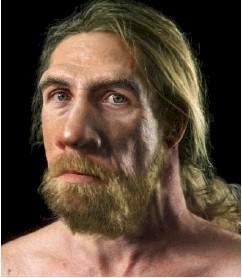
Modern reconstructions of Neanderthals show a great shift in our imagination. 


http://sciencegallery.com/content/museum-reconstruction-neanderthal-ap-getty-guardianjpg
http://www.sciencemusings.com/2005/09/rewriting-history.html
http://frontiersofzoology.blogspot.com/2011/06/cfz-repost-dale-drinnon-on-billikens.html
http://passionateabouthistory.blogspot.com/2010/10/at-last-recognition-for-3d.html
http://www.neanderthalproject.com/?tag=aspergers-syndrome
http://www.asexuality.org/en/index.php?/topic/79569-neanderthals-walk-among-us/
http://news.nationalgeographic.com/news/2012/10/121012-neanderthals-science-paabo-dna-sex-breeding-humans/

Well, I don't know if any of those are accurate....

... but I'm pretty sure this one is.

Couldn't resist!


http://www.google.com/imgres?imgurl=https://blogger.googleusercontent.com/img/b/R29vZ2xl/AVvXsEixLf7m66kne5ZL7uvon0U5Pb2dPtVjEhIRIUZu0F5BizgaBrxF3mFj-Lcf0K_nEt0RCv5QJ1nnmoTd1Lw3kdr-A4jqS8WPvKDcJTiLTh3kj0M6uqWV-wIfN4052siH-geUhDW568Opy2Sk/s1600/bush-neanderthal.jpg&imgrefurl=http://rightardia.blogspot.com/2010/11/reconstruction-of-neanderthal-female.html&h=306&w=220&sz=72&tbnid=XV3MQ9Jpm0HZNM:&tbnh=106&tbnw=76&zoom=1&usg=__EHnbbSYkIlk6VxY8ViKbTa1y4Hg=&docid=G6bCVH8IdDnTwM&sa=X&ei=y4ycUL-aMazDyQHstoDABw&ved=0CDMQ9QEwAA&dur=282


Bibliography

  • "Neanderthal Morphology." Zafarraya - Neanderthal. N.p., 4 Apr. 1998. Web. 9 Nov. 2012. <http://www.zafarrayaneanderthal.com/morph.html>.

Emergence of Neanderthals


http://teoria-evolutiei.wikispaces.com/Evolutia+omului


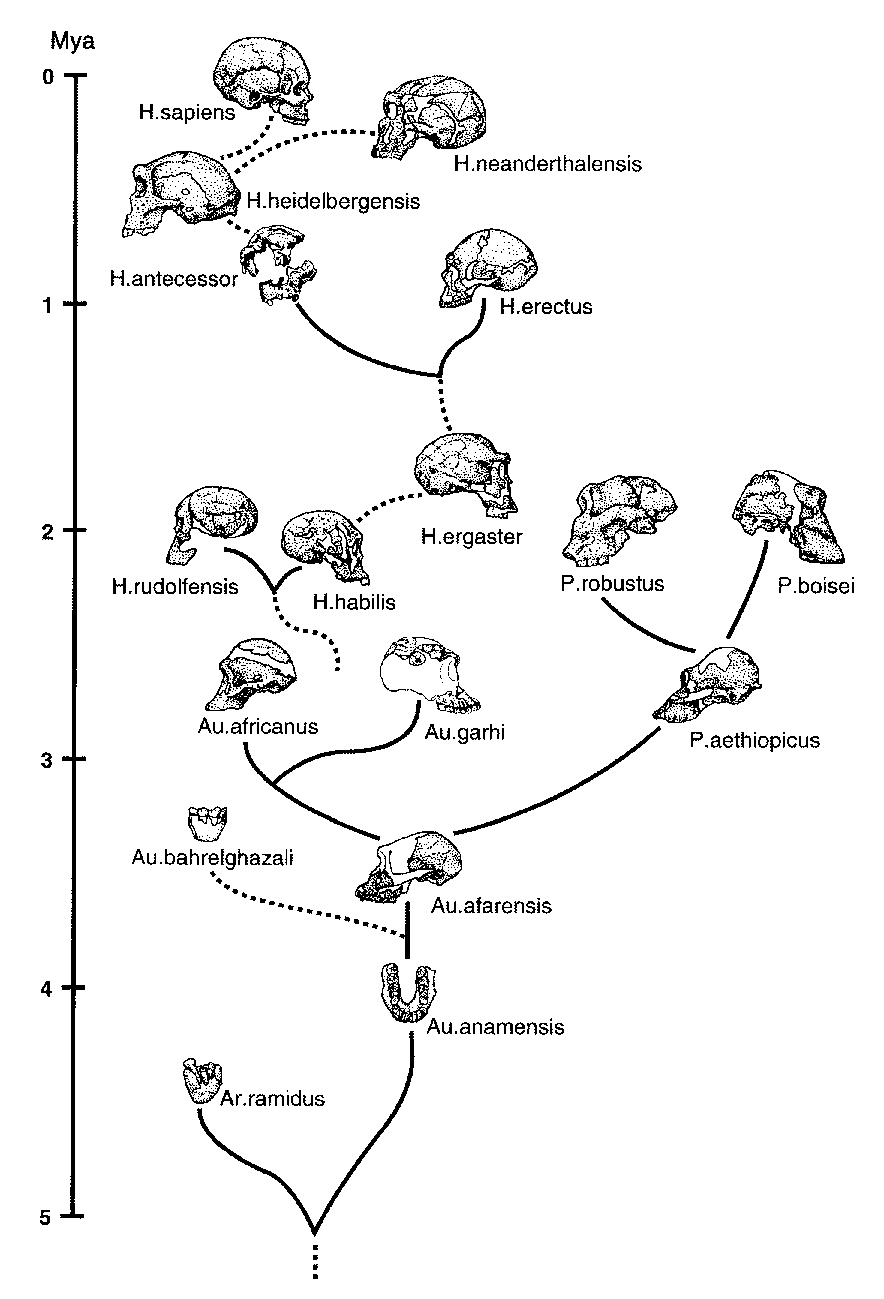
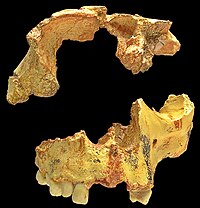
Most archeologists agree that both Neanderthals and AMH emerged out of Homo erectus.  The first H. erectus wave out of Africa is evidenced by specimen remains in Dmanisi, Ubeidiya, Zhoujoudian, and Trinil. Such a wide geographical range!

Bits of Homo antecessor 
http://en.goldenmap.com/Homo_antecessor

These specimens had distinct morphological characteristics (Maher 2012). For example, the Trinil H. erectus had more robust features than the Zhoukoudian H. erectus: its jaws were massive, its teeth are much larger, and its saggital keel and brow ridge were much more pronounced. Despite undeniable differences between H. erectus specimen, many archeologists consider the specimen in Gran Dolina, Atapuerca, Spain, to be its very own species--Homo antecessor.

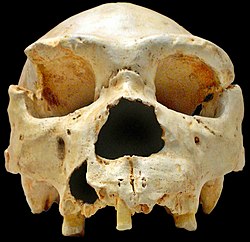
Homo heidelbergensis is often considered to be the last common ancestor of Neanderthals and AMH. This species first emerged out of Africa, but soon migrated to Europe and possibly to southern Asia by about 500, 000 kya.

Homo heidelbergensis


http://en.wikipedia.org/wiki/Atapuerca_Mountains

Homo heidelbergensis had a larger brain case, overlapping with the AMH average. They were also comparably tall at 6.0 ft, but more muscular. They used Acheulian tools, much like Homo erectus before them. Later populations were known to have also made tools from deer antler, bone and wood in addition to flint. There's plenty of evidence that they used weapons to hunt, like cut marks on large wild game.


http://www.echo-news.co.uk/news/local_news/southend/8232259.Humans_roamed_south_Essex_600_000_years_ago/

Neanderthals probably diverged from Homo heidelbergensis. The first Neanderthal specimen is dated to roughly 150,000-200,000 BP. However, some archeologists would date their emergence as late as 120,000 BP, and attribute earlier specimens to the Homo heidelbergensis. It's quite difficult to distinguish between the two species: their morphological characteristics were very similar.

The name "Neanderthal" derives from the Neander Valley near Dusseldorf, Germany. The specimens discovered at the site in 1856 were later found to be abnormal modern humans rather than archaic hominids. Two true Neanderthal skeletons were discovered in a cave at Spy, Belgium in 1886.

Bibliography 

  • Brown, Graham , Stephanie  Fairfax, Nidhi Sarao , and S. Anonymous . "Human Evolution." Tree of Life Web Project. Origins Institute at McMaster University , n.d. Web. 4 Nov. 2012. <http://tolweb.org/treehouses/?treehouse_id=3710>.
  • Dorey , Fran . "Homo antecessor - Australian Museum." Australian Museum - nature, culture, discover - Australian Museum. N.p., 2 Oct. 2009. Web. 31 Oct. 2012. <http://australianmuseum.net.au/Homo-antecessor/>.
  • "Homo heidelbergensis - Wikipedia, the free encyclopedia." Wikipedia, the free encyclopedia. N.p., 2 Oct. 2012. Web. 31 Oct. 2012. <http://en.wikipedia.org/wiki/Homo_heidelbergensis>.
  • Klein, Richard . "Neanderthal Range Map." Daily Nature and Science News and Headlines | National Geographic News. N.p., 6 May 2003. Web. 4 Nov. 2012. <http://news.nationalgeographic.com/news/2003/03/photogalleries/neanderthal/>.
  • Maher, Lisa. "From H. erectus to Neanderthals--Out of Africa I". Anthro 128, UC Berkeley, 105 Stanley, 9/7/2012
  • "Neanderthal - Wikipedia, the free encyclopedia." Wikipedia, the free encyclopedia. N.p., 8 Oct. 2012. Web. 4 Nov. 2012. <http://en.wikipedia.org/wiki/Neanderthal>.
  • Pedersen, Kristian. "Neanderthals, Lecture 9." Upload & Share PowerPoint presentations and documents. N.p., 15 Mar. 2010. Web. 31 Oct. 2012. <http://www.slideshare.net/KLRPedersen/neanderthals-lecture-9>.
  • Semal , Patrick et al . "New Data on the Late Neandertals: Direct Dating of the Belgian Spy Fossils." American Journal of Physical Anthropology 138 (2009): 421-428.